Figure
1: Interaural time differences
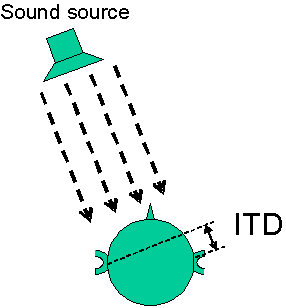
An important cue for the localization of sound sources is the interaural time difference (ITD). ITD is the result of the signal delay between two ears for sounds coming from the side (Blauert, 1974). For humans, the highest ITD in the real-world is about 600µs and depends on the head size.
Figure
1: Interaural time differences
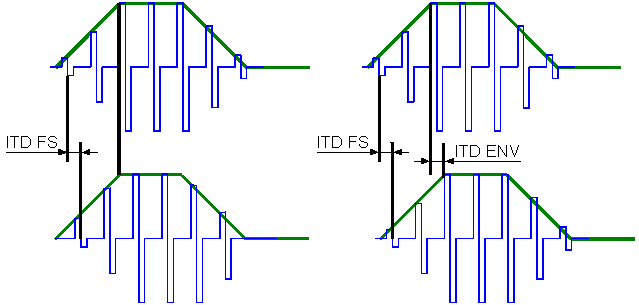
It is well established that ITD information in unmodulated signals can only be processed up to about 1500Hz (Wightman and Kistler, 1997). At higher frequencies the neural processing is too slow and thus not able to resolve the difference in the time. But, at higher frequencies a slow modulation of the carrier can transmit the ITD information (Bernstein, 2001). To encode this kind of ITD information, modulated signals, like speech are necessary. Using modulated signals at least two different types of ITD can be defined: ITD in the envelope (ITD ENV) and ITD in the fine structure (ITD FS). In the normal hearing (NH) literature, fine structure ITD is usually referred as the ITD of ongoing portion of signal or ongoing ITD.
Figure
2: Fine Structure ITD (ITD FS) and Envelope ITD (ITD ENV)
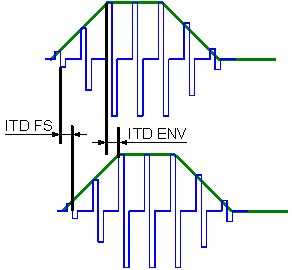
Signals with equal ITD ENV and ITD FS can be considered as a special case in that the whole waveform of one channel is delayed relative to the other channel. This case is most often found in natural signals and is referred to as waveform delay (WD).
Figure
3: Waveform Delay ITD (ITD WD), where ITD FS = ITD ENV
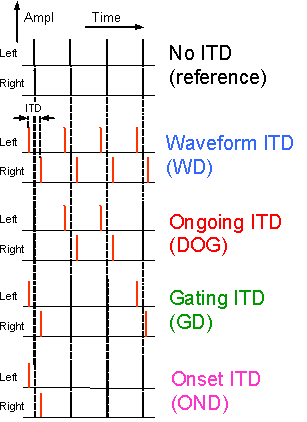
But even in unmodulated signals, such as pulse trains, different ITD types can be identified. Consider a simple pulse train, consisting of at least four pulses. For this stimulus following ITD types can be distinguished:
|
|
|
Using binaural four pulse stimuli, all these ITD types can be tested revealing the ITD sensitivity to different portions of a signal. Amplitude modulated pulse trains are more adequate for more real-world relation, like speech or music.